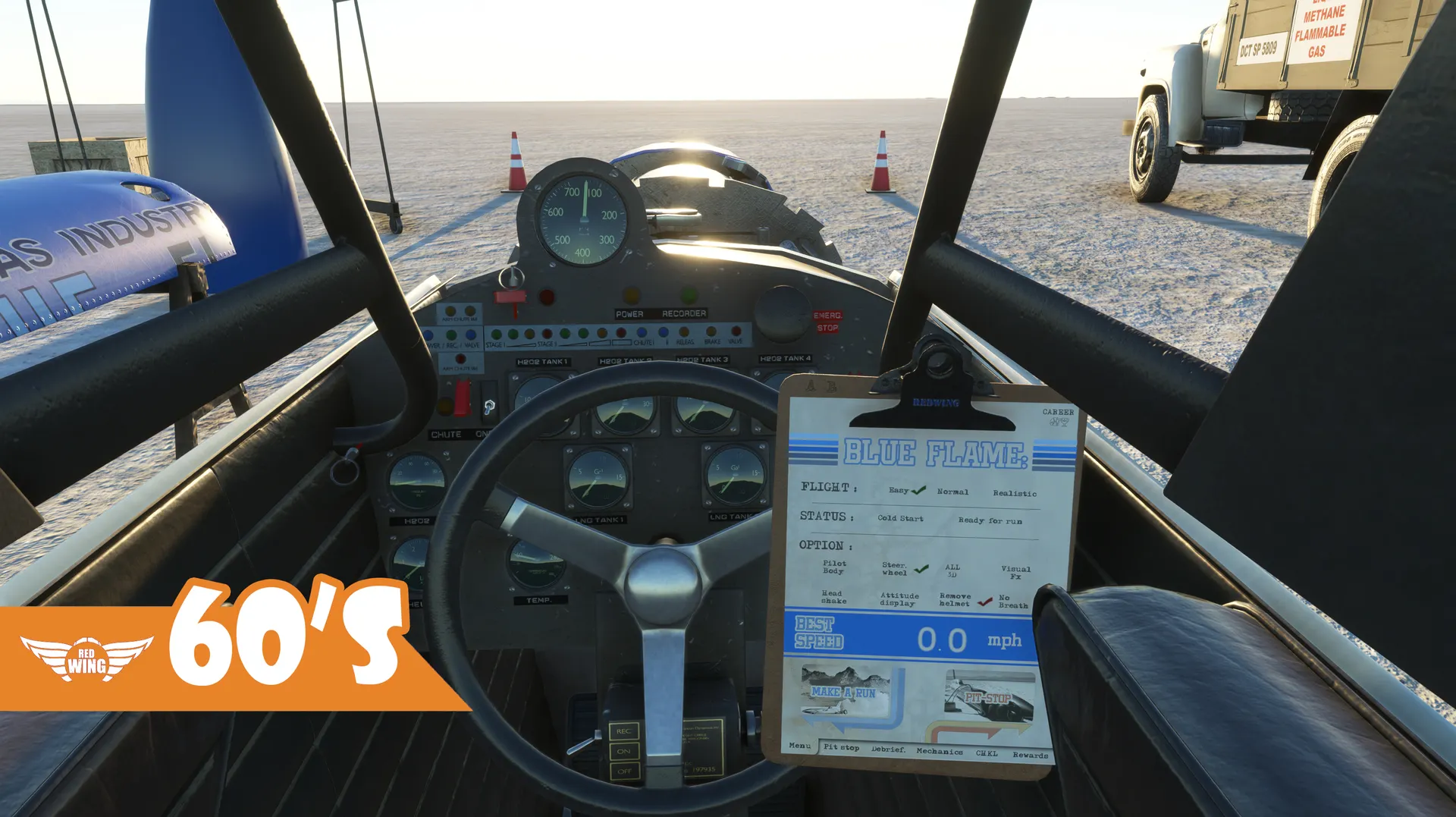
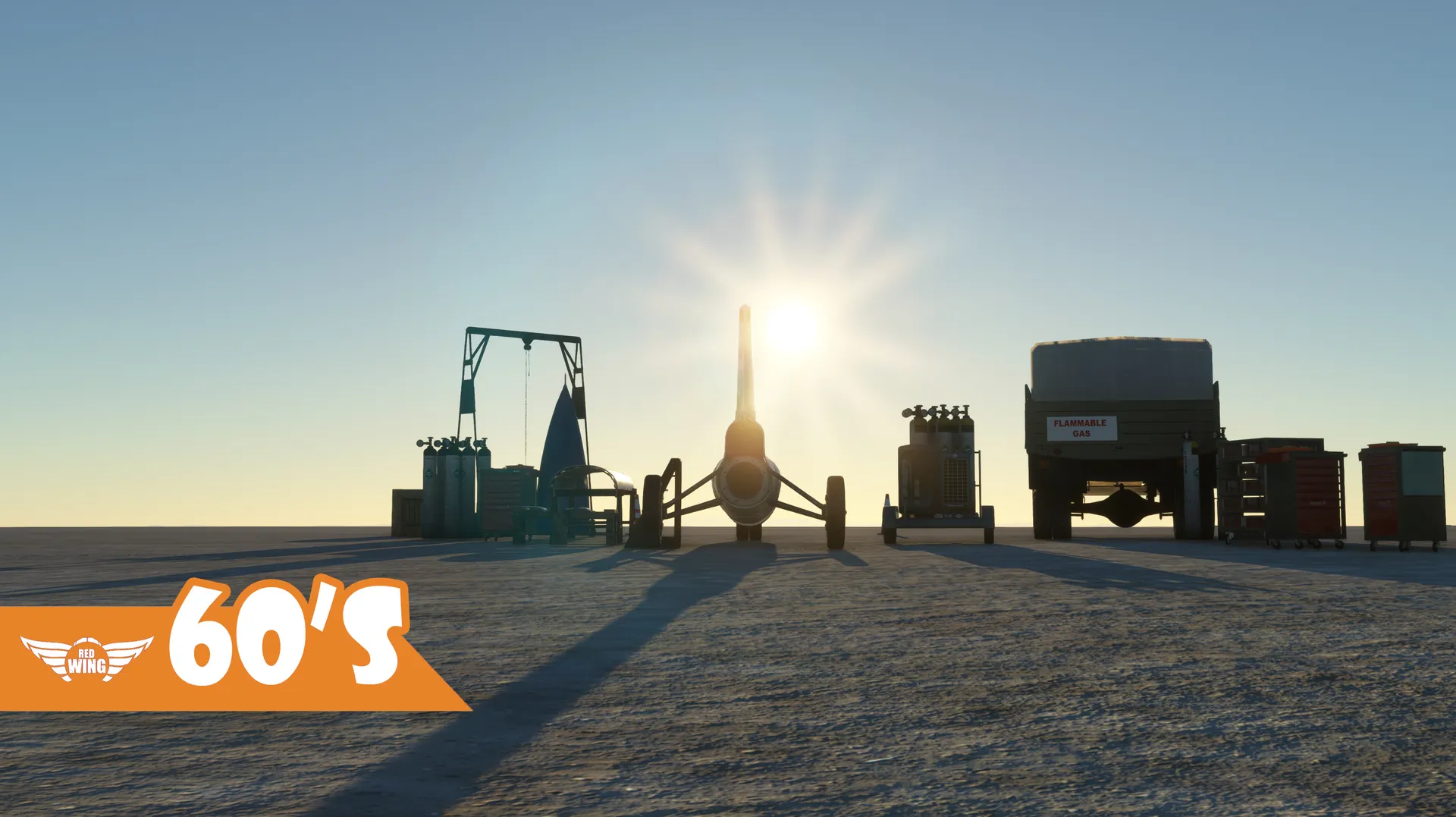
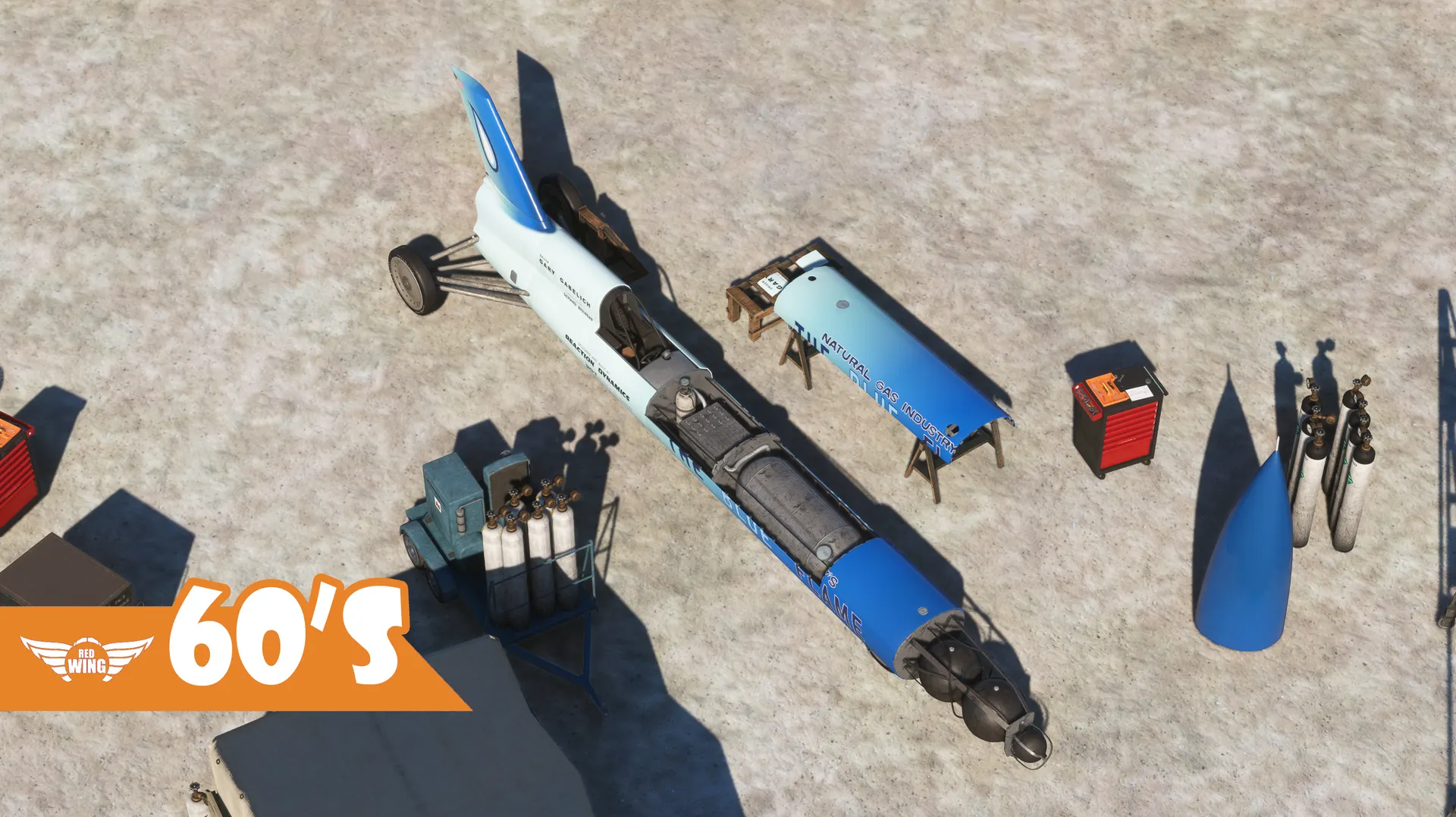
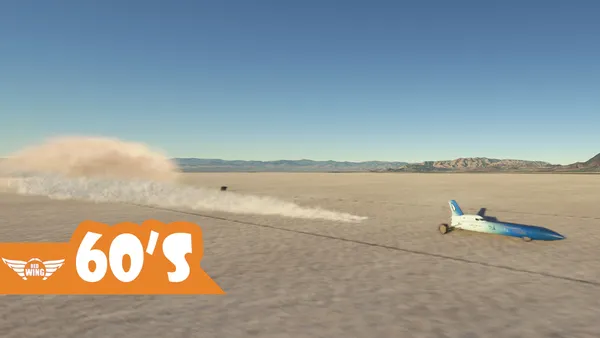
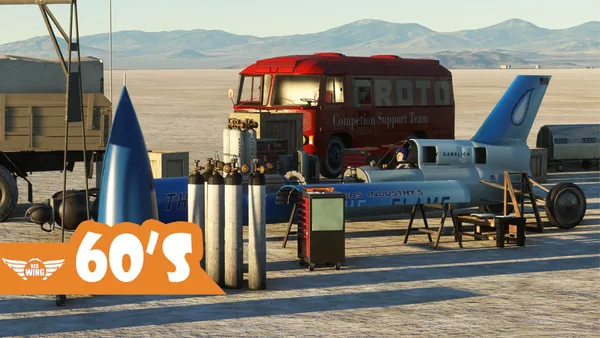
The Blue Flame is a rocket-powered land vehicle developed and produced by American experimental vehicle company Reaction Dynamics. The company’s engineers, working with experts from the Illinois Institute of Technology (IIT), developed the Blue Flame specifically to break a land speed record. Reaction Dynamics produced just one Blue Flame and it succeeded in its creators’ intent when it broke a land speed record on October 23, 1970 at Utah’s Bonneville Salt Flats.
The genesis of the Blue Flame began in the mid-1960s with the idea of creating a rocket-powered drag racing vehicle. Researchers from the Illinois Institute of Technology established Reaction Dynamics and created the X-1 drag racer. Also known as the “Rislone Rocket,” the X-1 was developed as a prototype to a larger, faster car—what would be the Blue Flame.
The X-1 was the first vehicle to be powered by a hydrogen peroxide-fueled rocket motor. The powerplant, which weighed just 57 pounds, generated 2,500 pounds of thrust, equivalent to 3,000 horsepower. During trials, the X-1 reached speeds of 229 miles per hour and induced acceleration forces of 2.6 gs.
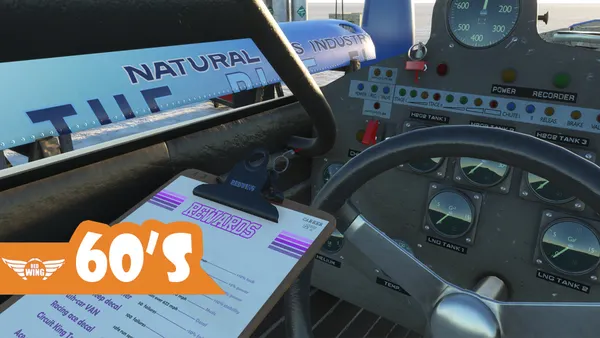
With knowledge gleaned from the successes of the X-1, the Reaction Dynamics team developed the Blue Flame. Engineers created a long, sleek body with a rear vertical stabilizer for which the United States Patent and Trademark Office would ultimately award a design patent. It is constructed of welded steel tubing and aluminum skin. It features an inverted, rounded triangle profile to mitigate the effects of shockwaves that might form at extreme speeds. The enclosed cockpit is located at the aft end of the body. It rides on three wheels, two that are widely spaced at the vehicle’s rear and one near the nose of the car. Goodyear developed special nitrogen-filled tires for the car and its speed attempts.
A liquid-fuel engine, similar to the one used in the X-1, powered the Blue Flame for its record attempt. The engine used a combination of hydrogen peroxide and liquified natural gas as propellent. The engine developed up to 22,500 pounds of thrust, the equivalent of 58,000 horsepower.
On October 23, 1970, the Blue Flame set two world speed records recognized by the FIA (Fédération Internationale de l'Automobile) at Utah’s Bonneville Salt Flats. These were the flying mile at 622.407 miles per hour (1001.67 kilometers per hour) and the flying kilometer at 1,014.52 kilometers per hour (630.388 miles per hour). “Flying” designates that an average speed is taken across two rolling-start runs. The records stood for more than a decade.
The Blue Flame measures 41 feet, 9 inches in length and its rear wheels are spaced 7 feet, 8 inches apart. Its body profile measures 2 feet, 6 inches wide by 3 feet high.
Today, the Blue Flame is on permanent display at the Auto and Technik Museum Sinsheim in Germany.